01
Name a moment in seconds
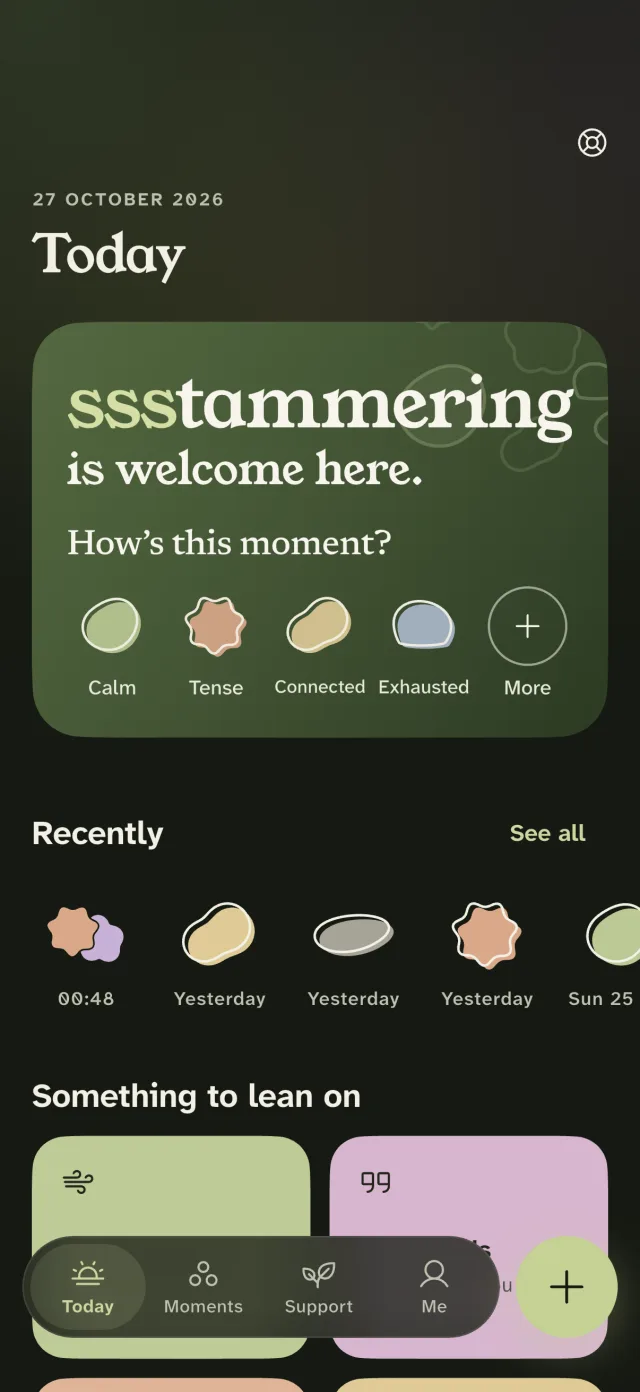
Pick how it felt and save. Mixed feelings are welcome, and so is “I don’t know”. You can use your own words too.

Free · For adults who stammer · iPhone and Android
A private journal for how life feels, not how speech sounds. Name a moment in seconds, keep it on your phone, and come back whenever you like. Made by two people who stammer.
What it won’t do
Try it
Pick any that fit, the way you would in the app. Mixed is normal, and so is not knowing.
Pick any that fit
Nothing you tap here is saved or sent. It disappears when you leave the page. In the app, you can also use your own words.
How it works
Everything after that is optional: now, later, or never.
01
Pick how it felt and save. Mixed feelings are welcome, and so is “I don’t know”. You can use your own words too.
02
Where you were, who was around and how they listened, what mattered to you, or a short reflection. None of it is required, and a moment can end without any of it.

03
See your moments as a calm canvas or a timeline, every one the same size. An optional weekly reflection describes your answers in words, never as a score or an average.

Small goals, in your words
Set a goal for something you’d like to do, or a way you’d like to feel, and break it into small steps if that helps. Link any moment to it, however it went.
Goals are never about sounding fluent. There are no streaks, scores or deadlines, and a goal you set aside is kept, not marked as failed.

Something to lean on
One gentle minute, or your own pace. No holds, and nothing to get right. It’s a moment to settle, never a speech technique.
Write how you’d like to tell people you stammer, or what you need from them, and keep it ready to copy or show. No apology needed.
Short practices for before or after a hard moment, links to stammering communities, and routes to urgent support, always one tap away.
Private by design
We can’t see what you write, and nobody else can either. There’s nothing to sign up for. You may have noticed there’s no cookie banner on this site, too: there’s nothing to agree to.
Grounded in research, honest about limits
Research on putting feelings into words, self-kindness and the everyday experience of stammering shaped how the app works. Inside, you can read the studies, who took part, and what they don’t show.
Beyond Fluency is a wellbeing journal for adults (18+). It isn’t therapy, a medical device or an emergency service, and it makes no claim to change your speech or your health.

About us
Most tools for stammering measure fluency: how smoothly you spoke, how many blocks, how many days in a row. A number like that can look better while someone swaps words, puts off calls or stays quiet, and it never notices the people who listened well.
We both stammer. We wanted one place for the whole picture: the hard moments and the ordinary ones, what mattered, and the small things we’d like to try, without anyone grading how we sound. We also want stammering to be talked about openly, so Beyond Fluency is free and non-profit, with no ads and nothing to sell.
Co-founder
Marco designs and builds the app, from the feeling shapes to the code that keeps your journal private on your phone.
Co-founder
Tea’s health psychology research at RCSI University of Medicine and Health Sciences explores how adults who stammer recognise their own strengths and ways of coping. It gave the app its name.
The research behind the name
Tea Falade and M. Szczerbinski. RCSI University of Medicine and Health Sciences, 2026. Conference poster.
The study listened to 13 adults who stammer in Ireland and the UK, through interviews and open survey answers. People described strengths they had built through living with a stammer, such as empathy, resilience, self-awareness and adaptability, and ways of coping that went well beyond speech techniques, including self-acceptance and acting on what matters to them. It concluded that support should look beyond a sole focus on fluency, and pointed to coaching that is non-judgemental, aware of strengths and built around small, achievable goals.
That’s the heart of the app: name the moment, notice what mattered, and set small goals of your own. It was a small qualitative study, so it shaped our design. It doesn’t show that the app works, and we don’t claim it does.
Supported by

EaseTalk is a Cork company whose app helps speech and language therapists support people between sessions. Nothing from your journal is shared with them, or with anyone else.